
How does drought affect crops? Effects of drought in agriculture
The effects of drought in agriculture are manifested by:sudden inhibition of plant physiological processes, which directly translates into a reduction in yield potential by up to several dozen percent. In conditions of moisture deficiency, crop plants immediately close their stomata to limit transpiration, which also stops the photosynthesis process. The lack of free flow of water in the plant prevents the transport of nutrients obtained from mineral fertilisers. As a result, even if the crop is fully supplied with nitrogen or potassium, the canopy begins to reduce the number of productive shoots, ear buds or pods. The long-term impact of this phenomenon is a drastic decrease in the thousand seed weight (MTN) and deterioration of the quality parameters of the harvested grain.
Water deficit in the soil – why does the field lose moisture quickly?
The main cause of the rapid loss of moisture by the field is water deficit in the soil caused by the degradation of its lumpy structure and a decrease in the level of organic matter. When the earth loses its natural porosity, the so-called capillaries and mesopores, which are responsible for long-term storage of rainwater, disappear. The top layer of the site becomes susceptible to crusting, which accelerates the process of evaporation, i.e. direct evaporation of water from the ground, during hot weather. This problem intensifies in simplified systems, where the lack of appropriate biological protection of the substrate causes each natural water gap to be destroyed under the influence of heavy equipment. In such conditions, even intense but short-lived rain does not penetrate deep into the profile, but flows down the surface, leaving the root zone dry.
Signals that your soil is not storing water
Signs that the substrate has lost its retention capacity include: visible physical changes on the field surface and unnatural behavior of plants after just a few days without rainfall. To correctly diagnose the condition of your station, it is worth analyzing the following symptoms:
- Cracks and crevices on the ground surface, appearing shortly after the rainfall stops.
- The phenomenon of dust drift and susceptibility of the top layer to wind erosion during spring cultivation.
- Quick drying of lower leaves crop plants, while the upper floors show wilting symptoms (maize curling, rapeseed wilting).
- Shallow root system, which develops only in the arable layer and does not penetrate deeper parts of the profile.
- Water logging in depressions in the ground immediately after a downpour, with no moisture at the depth of 10-15 cm.
How to reduce the effects of drought without waiting for rain?
In order to effectively reduce the negative consequences of rainfall deficiency, it is necessary to: permanently rebuild the natural sorption capacity and biological activity of the substrate. Ad hoc actions, such as standard foliar fertilisation, bring only a short-term effect if the root system does not have access to moisture in the structured zone. The key to success is the implementation of technologies that bind water in the soil in forms that are easily accessible to crops. By stimulating humus-forming and microbiological processes, you can create a stable water buffer that allows the crop to survive rainless periods. This strategy allows the yield stability to be independent of temporary weather anomalies.
Increasing the humus content in the soil as a foundation for retention
Increasing the humus content in the soil is the most important element in building stable retention, because humus particles have ability to bind water in an amount exceeding their own weight. Humus acts in the soil profile like a natural sponge, retaining moisture from winter and spring rainfall and preventing it from irreversibly seeping into deeper geological layers. Humic compounds also determine the formation of durable sorption complexes that stop nutrients from being washed out. Regularly taking care of the level of organic matter directly translates into higher plant resistance to abiotic stresses. A higher level of humus is also an optimal environment for the development of beneficial microorganisms that constantly cooperate with the root system.
Humic acids and drought – how to retain water in the soil?
The answer to the question of how to retain water in the soil lies in mass introduction into the soil concentrated organic substances, among which active humic acids play a key role – drought then ceases to be a completely destructive factor. These compounds have unique physicochemical properties that allow for long-term gluing of mineral particles into durable aggregate structures. Thanks to this, water in the root zone does not evaporate rapidly under the influence of high temperatures, but is dosed to the plant in a balanced way. Additionally, these acids stimulate cell division processes in young plant tissues, which accelerates the initial start of the crop. The use of proven humus preparations is a proven method for optimizing water management in any type of crop rotation.
How to improve soil structure to stimulate root development?
To effectively stimulate the development of the root system, the aggregate structure of the substrate must be permanently improved providing organic and mineral components and activation of soil microorganisms. The loose yet stable lumpy structure creates optimal air and water conditions, eliminating the mechanical resistance encountered by young roots. In such an environment, plants build a deep and highly branched root system much faster, capable of absorbing moisture from the deeper layers of the profile. A strong root allows for efficient uptake of nutrients even when the top layer of the field is temporarily dry. To achieve such an effect, it is necessary to implement advanced biological solutions that permanently transform soil architecture.
Water management regeneration with Agrizaz technology
Effective regeneration of the damaged water management of a cultivated site requires implementation advanced biological and organic solutions, which act directly on the structure of the soil profile. Traditional agricultural methods rarely bring immediate improvement in the face of an ongoing rainless period. The technology developed by Agrizaz is based on delivery highly reactive humic substances and selected strains of microorganisms. These compounds immediately react with the mineral fraction of the substrate, creating stable sorption complexes capable of accumulating liquid. The introduction of these products into the cultivation technology allows the site’s potential to be permanently secured and production independent of the vagaries of the weather.
Higher soil water capacity thanks to the HUMUS AGRO line
The higher water capacity of the soil is a direct result of the use of preparations from the HUMUS AGRO line, which introduce into the root environment a concentrated form of active humic acids. These substances have a unique molecular structure, acting in the soil as a molecular mesh that stops water molecules from flowing out due to gravity. By increasing overall retention, crop plants gain constant access to the soil solution, which allows them to continuously absorb the necessary nutrients. This line significantly reduces the negative effects of soil drought by stabilizing cellular turgor in plant tissues. Regular introduction of these components into the soil permanently improves the physicochemical parameters of the site over the subsequent growing seasons.
PLONAGRO and HUMUS AGRO BOOSTER – protection of plantations against stress
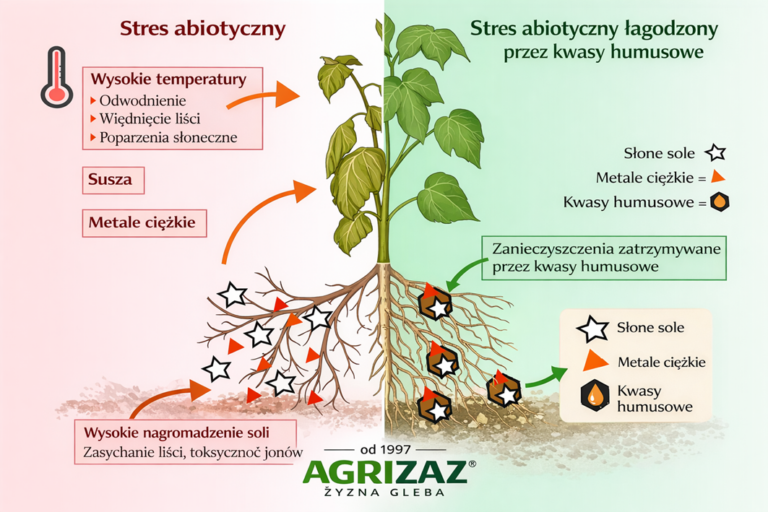
Use of preparations PLONAGRO and HUMUS AGRO BOOSTER guaranteed multi-level protection of plantations against the effects of deep water and thermal stress. The first of the mentioned products, thanks to the high content of potassium integrated with humic acids, optimizes water management inside the plant itself and regulates the functioning of stomata. The second preparation provides active fulvic acids that stimulate the rapid synthesis of immune proteins in leaf cells, protecting them against degradation under the influence of strong sunlight. The combination of these two technologies allows you to maintain the continuity of metabolic processes in rapeseed, maize and cereals even in extremely unfavorable microclimatic conditions. This treatment is an effective investment in the stability of yields.
Increase the resistance of your crops – join Patron Farms
Implementing a comprehensive soil protection strategy against drought requires constant monitoring and adapting the technology to the specificity of a specific farm. Program Patronage Farms AGRIZAZ offers farmers full substantive and technological support in the process of regenerating the yield potential of soil. Program participants gain direct access to expert knowledge, individual biological fertilisation plans and the latest solutions aimed at water retention. Practical experience collected in fields across the country confirms that a systemic approach to humus reconstruction brings measurable production results. Participation in the project is an opportunity to modernize cultivation technology and permanently secure the profitability of plant production.
Summary
Agricultural drought does not have to mean a drastic drop in yields, as long as the foundation of production, which is efficiently functioning soil, is taken care of at the right time. Limiting water losses through evaporation and stimulating the deep root system are the only effective methods of combating rainfall deficit. AGRIZAZ technology based on humic and fulvic acids and beneficial microorganisms provides proven tools for permanent reconstruction of the lumpy structure of the substrate. Don’t wait for drought to destroy your yield potential.
Start actively managing moisture in your fields, check out the full range of innovative products and contact an advisor on the website: https://www.agrizaz.pl/