
Strona główna > Produkty > Humus Agro for Crop Residues – Organic Matter Decomposition Product
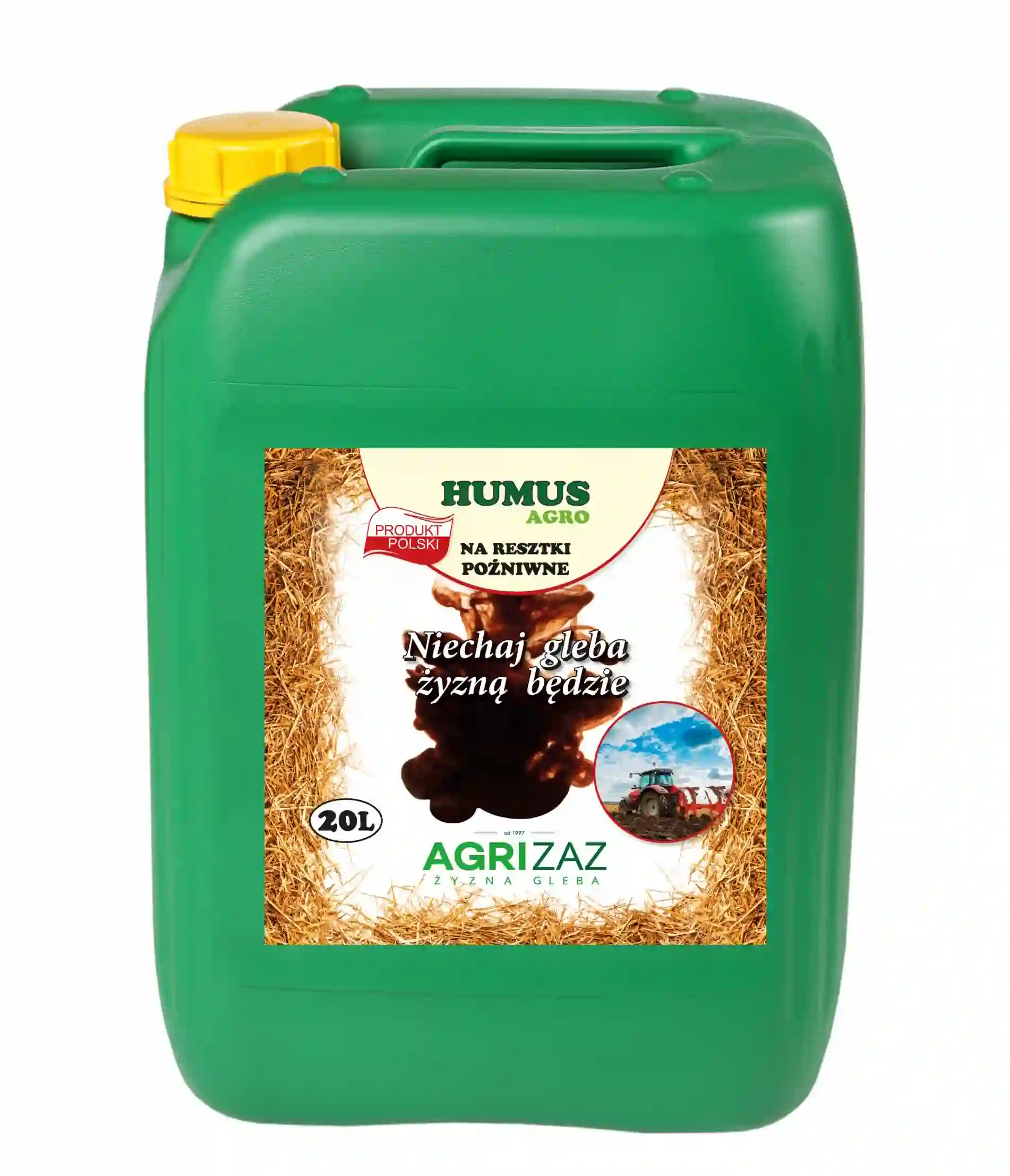
Humus Agro for crop residues is a specialized preparation intended for the comprehensive decomposition of crop residues and green matter. Rich, additionally multiplied bacterial microflora and sugars supporting its development accelerate the decomposition of organic matter and the release of nutrients contained in it. The product contains 30% humic acids, 11% dry matter and clay minerals supporting water retention in the soil and moisturizing organic matter.


We would like to inform you that the product Humus Active for crop residues is being renamed Humus Agro for crop residues. The change concerns the graphic design and trade name – it is a new standard of professionalism in agriculture while maintaining the same patented technology.

Discover the benefits
Humus Agro for crop residues supports the decomposition of cereal and rapeseed straw, corn, beet and potato harvest residues and various types of catch crops grown for green manure. Cellulolytic bacteria specialize in the decomposition of organic matter and make available the nutrients contained in it, and sugars accelerate the multiplication of positive bacterial microflora. Permanent Active Humus captures and retains ingredients derived from the mineralization of organic matter, limiting their losses caused by leaching and deterioration.
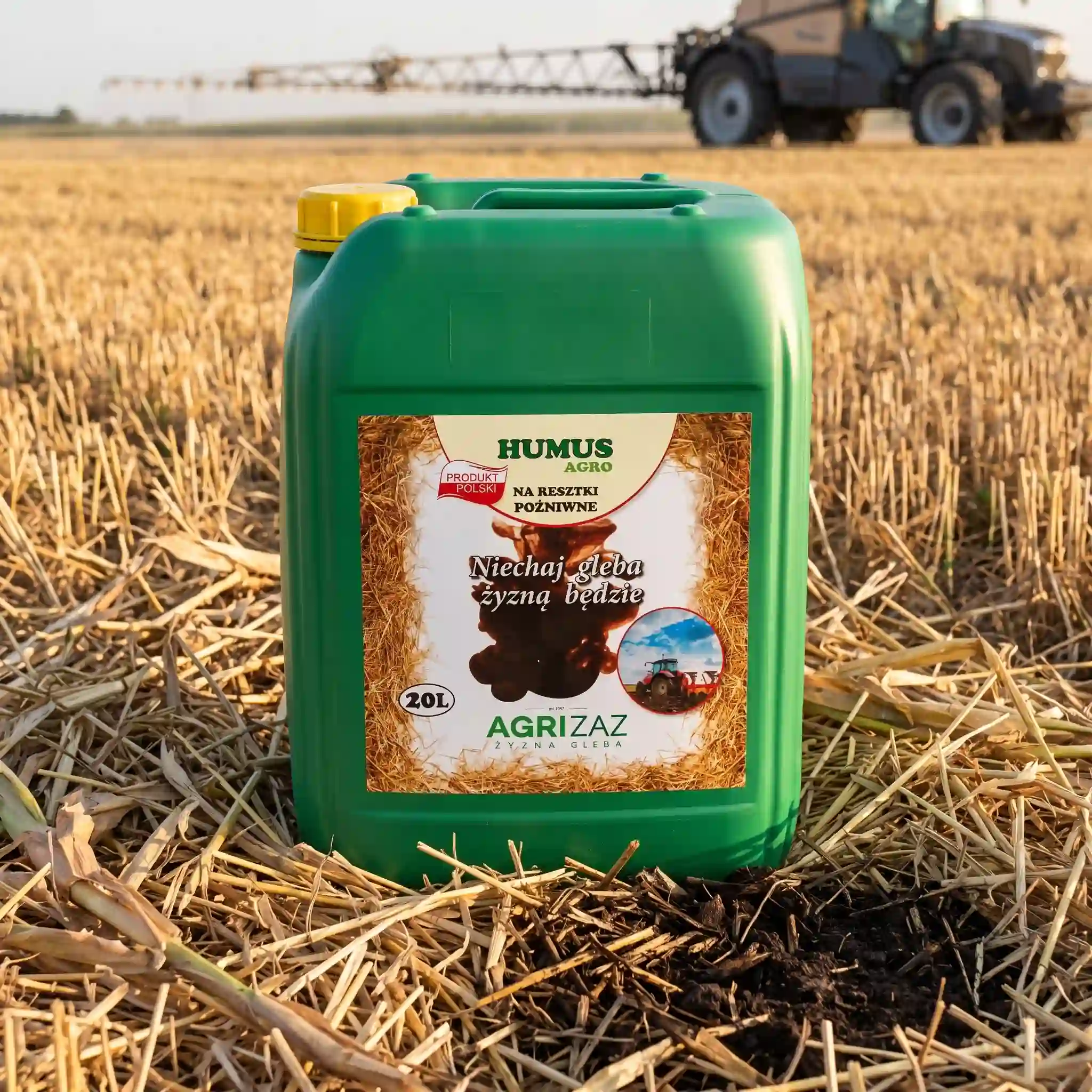
Clay minerals help maintain water in the soil and adequate moisture of organic matter, supporting microbiological activity. Humus Agro for crop residues improves the soil structure, optimizes its air-water relations and promotes even plant emergence. Beneficial fungi of the Mycorrhiza and Trichoderma genera colonize the soil, limiting the development of pathogenic fungi and soil-borne diseases.
Product composition
Humus Agro for crop residues contains 30% humic acids from selected, young lignite deposits, including humic acids, fulvic acids, humins and ulmins. The product contains 11% dry matter and positive microflora at the level of 10⁷ JTK. The formula is complemented by beneficial mushrooms, natural proteins and amino acids, substances and enzymes that stimulate growth, sugars that support the development of positive bacterial microflora and clay minerals that retain water in the soil.
The preparation contains 30% humic acids from selected, young lignite deposits, including humic acids, fulvic acids, humins and ulmins. The composition is complemented by a complex of macro- and microelements: minimum (m/m) nitrogen (N) 0,02%, phosphorus (P₂O₅) 0,30%, potassium (K₂O) 0,55%, magnesium (MgO) 0,05% and calcium (CaO) 0,30%. The product also contains iron (Fe) 450,0 mg/kg, manganese (Mn) 15,0 mg/kg, zinc (Zn) 3,0 mg/kg and copper (Cu) 1,0 mg/kg. Clay minerals help retain water in the soil and moisten organic matter.
Cellulolytic bacteria contained in Humus Agro for crop residues specialize in the decomposition of organic matter and make available the nutrients contained in it. The addition of sugars accelerates the multiplication of positive bacterial microflora in the soil, supporting faster decomposition of organic matter and making valuable macro- and microelements available.
Azotobacter bacteria contained in the preparation bind and make atmospheric nitrogen available to plants, while phosphorus bacteria make phosphorus available from sedimentary forms. Bacteria of the Bacillus genus produce natural enzymes that stimulate plant growth and reduce the occurrence of soil-borne diseases. Together with cellulolytic bacteria, they create a rich microflora that supports the decomposition of organic matter.
Application method
In optimal weather conditions, it is recommended to use 10 l Humus Agro for crop residues in 300 l water for 1 ha. The preparation can be used in spring, summer and autumn before planned crops, at temperatures above 5°C. It is recommended to mix the sprayed soil with crop residues no later than the next day after applying the product.

Have additional questions? Contact us – we’ll be happy to advise you.
Humus Agro for crop residues can be used in spring, summer and autumn before planned cultivation. In optimal weather conditions, the recommended dose is 10 l of the product per 300 l of water per 1 ha, and the treatment should be performed at a temperature above 5°C. It is recommended to mix the sprayed soil with crop residues no later than the next day after applying the product.
During drought, Humus Agro should be applied to crop residues at a dose of 20 l/ha in 600 l water, in spring, summer or autumn before the planned cultivation, at a temperature above 5°C. It is recommended to mix the sprayed soil with crop residues no later than the next day after using the product. If nitrogen was previously used to decompose organic matter, the dose of Humus Agro for crop residues can be reduced to 5 l/ha in 300 l water.
To apply Humus Agro to crop residues, use an efficient sprayer equipped with a mixer and coarse-drop nozzles with a minimum diameter of 0,4 mm or nozzles intended for RSM. Filter density should be below 60 Mesh.
The preparation must not be combined in one spray with plant protection products, mineral fertilisers and other chemical synthesis products . These substances can permanently damage the active bacterial microflora and beneficial fungi, drastically reducing the effectiveness of the treatment. If you have any questions about compatibility with other biological methods, please contact our advisors!
Information
Humus Agro for crop residues is qualified for use in organic farming. The product has a permit from the Ministry of Agriculture and Rural Development No. G-1808/25, in accordance with the current product documentation.

Humus Agro for crop residues combines 30% humic acids with a rich, additionally multiplied bacterial microflora, sugars and clay minerals. Cellulolytic bacteria support the decomposition of organic matter, and sugars accelerate the multiplication of positive microflora. Clay minerals help maintain water in the soil and adequate moisture in organic residues, supporting microbiological activity.
When decomposing crop residues, it is worth using a solution that simultaneously supports the decomposition of organic matter, soil microbiological activity and the retention of released nutrients. Humus Agro for crop residues contains cellulolytic bacteria, phosphorus bacteria, Azotobacter and Bacillus, as well as sugars, beneficial fungi and humic acids. Thanks to this, it supports the decomposition of residues and preparation of the soil for the next sowing.
Humus Agro for crop residues is a preparation intended for the comprehensive decomposition of crop residues and green matter, including cereal and rapeseed straw, corn, beet and potato residues and catch crop mass. It contains, among others, cellulolytic bacteria, sugars supporting the development of microflora and 30% humic acids. The product is qualified for use in organic farming and has permission MRiRW No. G-1808/25.
The decomposition of crop residues can be supported by providing cellulolytic bacteria along with sugars that support the multiplication of positive bacterial microflora. In optimal conditions, Humus Agro is applied to crop residues at a dose of 10 l/ha in 300 l water, at a temperature above 5°C. It is recommended to mix the sprayed soil and residues no later than the next day after treatment.
After harvest, Humus Agro can be applied to crop residues, which supports the decomposition of straw and the recovery of nutrients bound in organic matter. Cellulolytic bacteria participate in the decomposition of matter, while Permanent Active Humus captures and retains ingredients originating from mineralization, limiting their losses caused by leaching and deterioration.
Participation in the National Patronage Farms Program is the most effective way to reduce production costs while increasing soil fertility. Farmers participating in the program can purchase Humus Agro for crop residues with a discount of 50%, bypassing the margins of intermediaries and using the manufacturer’s direct logistics. This is a strategic solution for farms seeking economic optimization of straw mineralization and humus building processes.
We value user privacy
We use cookies to improve browsing quality, display content tailored to user needs and analyse traffic on the website. Clicking the Accept all button means consent to the use of cookies in accordance with the selected settings. Privacy policy

Customize preferences
Choose which categories of cookies you want to consent to.
Necessary cookies are required for the proper functioning of the website. They enable its core features such as security, session handling and saving privacy settings. These cookies cannot be disabled in this panel.
Preference cookies allow the website to remember selected settings and adapt it to your choices, for example language, appearance or other interface preferences. Enabling them is optional.
Analytics cookies help us understand how users interact with the website. They allow traffic analysis and statistics measurement, which helps improve the performance and usability of the service. Enabling them is optional.
Marketing cookies may be used to tailor advertising content to your interests and to measure the effectiveness of marketing activities. Enabling them is optional.