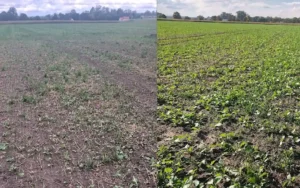
When to start shallow post-harvest cultivation?
Shallow post-harvest cultivation should be started within 24 hours after the combine leaves the field. This quick reaction protects the soil profile against water losses caused by heat.
Post-harvest tillage mixes the remains with the top layer of earth, creating a protective mulch. Additionally, stubble cultivation stimulates self-seeding seeds and weeds to germinate, which makes them easier to remove later.
How quickly does stubble lose water after harvest?
Exposed stubble loses from 3 to 5 liters of water from each square meter within 24 hours. The sun heats the ground strongly, and moisture from deeper layers escapes straight into the air through natural channels in the ground.
Post-harvest cultivation creates a barrier on the surface, which blocks this process and stops the field from drying out. Retaining these several millimeters of water in the soil is essential for the sown plants to grow evenly and quickly, even during drought.
The most common mistakes during stubble cultivation
The most serious mistake is loosening the soil above optimal 5-8 centimeters of depth. Tillage that is too deep dries out the lower parts of the field, brings hard clods to the surface and causes unnecessary, higher fuel consumption.
For the treatment to bring the expected results, avoid:
- Entering the field after 48 hours after harvest, which leads to the formation of a hard crust on the surface.
- Uneven scattering of straw, which hinders its quick decomposition and transformation into valuable humus.
- Lack of compaction of the top layer of soil due to poor adjustment of the embankments to soil moisture.
Shallow post-harvest cultivation and the phenomenon of evaporation
Shallow post-harvest cultivation effectively inhibits the evaporation of water from the soil. Quickly breaking up the stubble destroys the natural channels in the ground through which water escapes upwards and creates a protective layer on the surface.
Such a treatment protects the land against the effects of severe drought. Maintaining appropriate humidity means that the fertilisers sown dissolve easily and the plants can use them without any problems.
What happens after stubble work? Water retention for longer
Mechanical cultivation is only a temporary solution. To permanently store water from summer rains, the soil structure must be improved so that it behaves like a sponge.
They come to help soil humus fertilisers, which provide valuable organic matter to the earth. This treatment retains moisture around the roots for a long time, safely protecting future crops from drying out.
Humus Agro fertiliser for drought
Humus Agro for drought is a natural preparation that significantly slows down the drying of the soil. It combines humic acids, minerals and beneficial bacteria that retain water molecules in the substrate.
To get the best yields from it, three simple steps are enough:
- Measure the dose carefully using clean water.
- Spray while mixing crop residues with the soil.
- Cover the preparation with a thin layer of soil so that the sun’s rays do not destroy beneficial microorganisms.
This procedure allows for maximum protection of water in the field immediately after harvest.
Invest in fertile soil – check out the Agrizaz offer
Shallow post-harvest cultivation combined with the application of humic acids to the soil is the basis for profitable agriculture in unpredictable weather. Retaining water in the ground makes traditional NPK fertilisers work more effectively and seeds grow evenly.
Don’t risk that autumn drought will destroy your harvest. Choose proven Polish biological solutions. Consult your action plan with our experts and take care of your soil now: https://www.agrizaz.pl/