How to decompose crop residues? The best solutions
The most effective way to decompose crop residues is biological spraying with microorganisms and humic acids. Hard straw contains cellulose and lignin, which decompose very slowly in the soil without the support of bacteria.
The mere plowing of straw during drought creates the so-called straw pillow, which blocks water from seeping into the roots. Biological spraying accelerates humification, i.e. the quick transformation of straw into fertile humus. As a result, the nutrients trapped in the plant return to the soil and are easily available for subsequent crops.
Does the traditional dose of nitrogen on stubble still make sense?
Application of mineral nitrogen to stubble is currently unprofitable and harmful to the soil environment. Nitrogen is traditionally applied to prevent nitrogen starvation, when bacteria use nitrogen from the soil to digest straw.
However, loose nitrogen does not provide the soil with humus, and during drought it crystallizes on the surface and acidifies it. Much better results are achieved by administering Positive Microorganisms (PM) with humic acids. These bacteria regulate the carbon to nitrogen ratio by breaking down straw without having to purchase expensive chemical fertilisers.
What is best for crop residues – chemistry or biology?
Definitely the best choice for crop residues is biology, because it permanently rebuilds humus and does not acidify the soil. Chemical fertilisers provide only individual elements, but destroy the lumpy structure of the substrate.
Biological preparations introduce cellulolytic bacteria and saprophytic fungi, which quickly digest hard lignin. Additionally, beneficial microorganisms displace harmful pathogens from the stubble, protecting winter crops against Fusarium blight and dry rot. In the long term, biology releases free potassium and phosphorus from the straw, bringing real savings.
Humus Agro for crop residues – a biological breakthrough
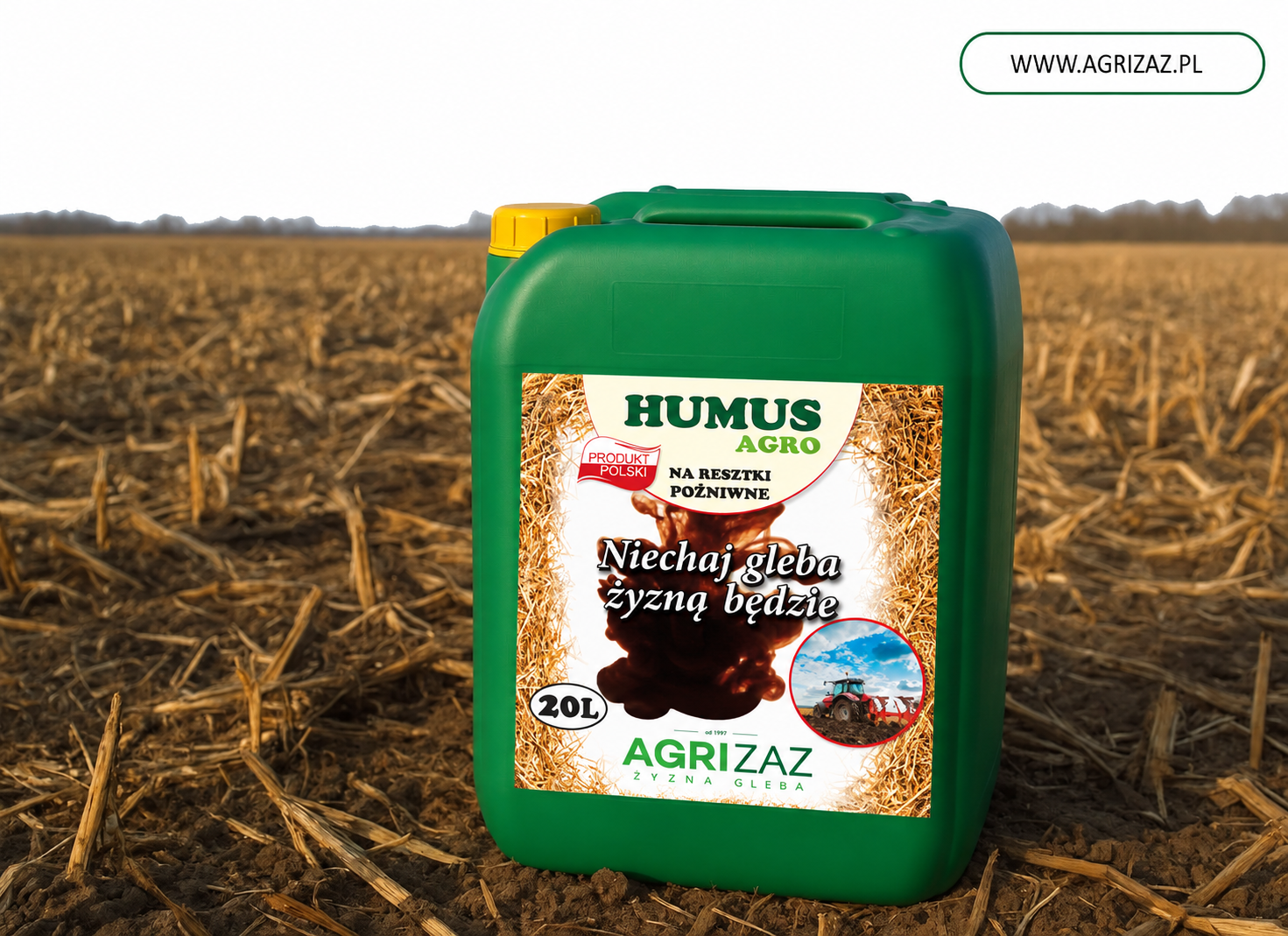
Humus Agro for crop residues is a preparation combining 55% concentrated humic acids with Positive Microorganisms and a built-in enzymatic medium. Humic acids create a stable water-retaining sponge in the soil, and microorganisms immediately decompose the organic matter.
The bacteria contained in the preparation work intensively even in lower autumn temperatures. Thanks to this, the farmer replaces expensive mineral nitrogen with safe, natural biostimulation.
What are the advantages of combining humic acids and biology?
The combination of humic acids and biology guarantees shock decomposition of straw, because the acids create a safe environment for bacteria, which produce permanent humus. Acids alone without microorganisms act slowly, and biology itself without a carbon matrix quickly dies in difficult conditions in the field.
Here are the most important benefits of this connection:
- Fast straw decomposition: Bacillus bacteria and cellulolytic organisms rapidly digest cellulose and lignin.
- Protection against drought: An increase in the soil’s sorption capacity allows it to retain moisture necessary for plant development.
- Free fertiliser: The humification process releases large amounts of easily accessible water from the straw potassium and phosphorus.
- Fewer soil diseases: Beneficial microorganisms occupy the stubble and block the development of pathogenic fungi.
How to effectively perform biological stubble spraying?
Biological stubble spraying is best done immediately after harvesting the main crop on straw and topsoil. The condition for success is even coverage of plant remains and maintaining moisture in the substrate.
For the treatment to bring maximum effect, it is worth following the steps below:
- Add starting fuel: It is worth adding nutrient to the working liquid Activor, which provides microorganisms with clean energy for immediate multiplication.
- Keep the spray clean: Agrizaz liquid preparations undergo filtration at the 200 Mesh level (74 micrometers), which guarantees full clarity of the solution.
- Choose reliability: The homogeneous mixture does not clog field nozzles and works perfectly with 4.0 Agriculture systems.
Turn straw into free fertiliser and rebuild soil fertility
The quick decomposition of straw turns crop residues into free fertiliser rich in potassium, phosphorus and nitrogen. Positive Microorganisms (PM) contained in the Humus Agro preparation for crop residues transform biomass into fertile humus, which retains moisture during drought and reduces soil-borne diseases.
Order the preparation with a discount on the website https://www.agrizaz.pl/ and start saving on fertilisation from this season!